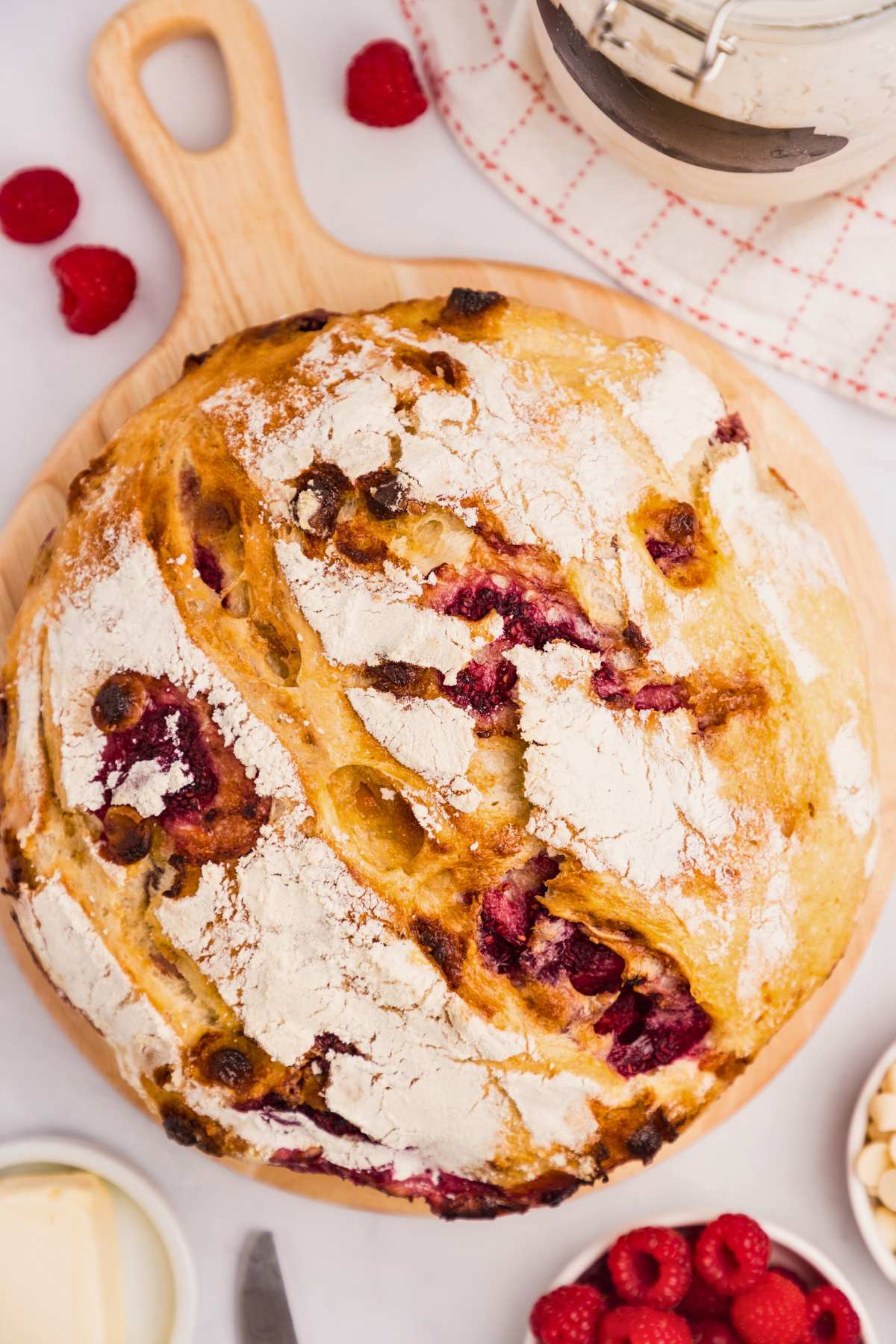

Making artisan sourdough at home can feel intimidating, but adding white chocolate and raspberries transforms a traditional loaf into a show-stopping centerpiece that tastes like it came from a professional bakery. The good news: the same time-tested fermentation methods that make sourdough special actually work in your favor here, developing deep flavor while you sleep. Whether you’re an experienced baker looking to experiment or someone curious about sourdough’s sweet possibilities, this recipe delivers impressive results with straightforward technique.
How to Make White Chocolate Raspberry Sourdough
This recipe yields one large loaf with a crispy crust and tender, slightly sweet crumb studded with white chocolate pieces and fresh or frozen raspberries.
Ingredients
- 500g bread flour (or all-purpose)
- 350ml water at room temperature
- 100g active sourdough starter (fed 4-8 hours prior)
- 10g salt
- 100g white chocolate chips or chunks
- 120g fresh or frozen raspberries (no thawing needed if frozen)
Method
Mix and Autolyse
Combine flour and water in a large mixing bowl, stirring until all flour is hydrated and no dry bits remain. Let this mixture rest at room temperature for 30-60 minutes. This resting period, called autolyse, helps develop gluten naturally before fermentation begins.
Incorporate Starter and Salt
Add your active sourdough starter to the rested dough along with the salt. Pinch and fold the dough 20-30 times until the starter is fully incorporated. The dough will feel shaggy and slightly stiff; this is normal. Continue folding until it becomes smoother and more cohesive, about 5-7 minutes of work.
Add Chocolate and Fruit
Gently fold in white chocolate pieces and raspberries using your hands or a rubber spatula. Be careful not to crush the berries excessively, though some breaking is fine as they’ll soften during fermentation. Distribute inclusions as evenly as possible throughout the dough.
Bulk Fermentation with Folds
Cover the bowl with a damp cloth or plastic wrap and let it ferment at room temperature (68-75F is ideal) for 12-18 hours. During the first 3-4 hours, perform 4-6 sets of stretch-and-fold motions every 30 minutes, gently pulling the dough up from the sides and folding it over itself. After the initial folds, let the dough rest undisturbed until it increases by roughly 50-75% in volume and shows visible bubbles on the surface.
Shape and Final Proof
Turn the dough onto a lightly floured surface and gently shape it into a round or oval boule using surface tension. Don’t aggressively work the dough; aim for a loose, gentle shape that traps air pockets. Place seam-side up in a floured banneton basket or bowl lined with cloth. Cover and proof at room temperature for 2-4 hours, or refrigerate overnight for easier scoring and deeper flavor development.
Score and Preheat
Place a Dutch oven or covered baking vessel in your oven and preheat to 450F for at least 30 minutes. This ensures maximum oven spring and crust development. If proofing in the refrigerator, the dough can go straight into the hot vessel; if at room temperature, work quickly to minimize temperature loss.
Bake Covered
Carefully invert the proofed dough onto parchment paper and score the top with a sharp blade using 1-2 decisive cuts. Transfer to the preheated Dutch oven and bake covered at 450F for 20 minutes. This traps steam, which creates a crispy, caramelized crust.
Finish Baking Uncovered
Remove the lid and bake for an additional 25-35 minutes until the crust is deep golden brown. The total bake time depends on your oven; look for an internal temperature of 205-210F when probed in the center. Cool on a wire rack for at least 1 hour before slicing, as the crumb continues to set during cooling.
- Use frozen raspberries instead of fresh–they hold their shape better during fermentation and won’t release excess moisture that weakens dough structure.
- If your kitchen is cold (below 65F), bulk fermentation will take longer; proof in a turned-off oven with the light on, or use a proofing box to maintain consistent warmth.
- Score your loaf confidently with a sharp blade at a 30-45 degree angle and at least 1/4-inch deep; tentative cuts close during oven spring and create uneven crusts.
What to Look For in Sourdough Baking Equipment
- Dutch Oven Capacity and Material: A 5-7 quart enameled cast iron Dutch oven provides even heat distribution and steam retention. The enamel coating prevents rust and eliminates seasoning requirements, while the heavy bottom ensures consistent baking.
- Banneton Basket Size: Choose a banneton sized for 1-2 pound loaves (typically 9-10 inch diameter). The spiral or rings help the dough proof without sticking, and natural cane construction allows moisture breathability.
- Bench Scraper or Dough Cutter: A stainless steel bench scraper with a wooden handle or grippy plastic edge makes dough handling cleaner and quicker. Look for a tool with clear measurement markings for portion control.
- Scoring Tools and Techniques: A dedicated bread scoring blade or lame creates clean, precise cuts that control oven spring. Avoid serrated bread knives, which tear rather than slice and produce ragged, uneven scoring patterns.
Le Creuset Enameled Cast Iron Dutch Oven 5.5 Qt
Best for: Serious home bakers seeking heirloom-quality baking vessel
Le Creuset’s iconic Dutch oven excels at sourdough baking with its superior heat retention, enamel coating that won’t chip, and tight-fitting lid that traps steam perfectly for a crispy crust. The 5.5-quart capacity accommodates large artisan loaves with room to spare, and the cookware is fully compatible with all cooktops and ovens. Lifetime warranty provides peace of mind.
Check Current Price on Amazon →Lodge Enameled Cast Iron Dutch Oven 6 Qt
Best for: Budget-conscious bakers unwilling to compromise on performance
Lodge delivers American-made cast iron quality at a fraction of the price. The 6-quart enameled Dutch oven performs identically to premium brands for sourdough steaming, with excellent heat distribution and a smooth enamel interior that prevents sticking. Lodge’s lifetime warranty demonstrates confidence in durability.
Check Current Price on Amazon →Banneton Proofing Basket Round 10 Inch by Artisan
Best for: New sourdough bakers learning proper shaping and proofing
This 10-inch round banneton basket simplifies dough handling for single loaves, with a natural cane construction that prevents sticking without greasing. The integrated spiral pattern marks the dough beautifully, and the basket is lightweight enough for frequent use. Includes a linen cloth liner sized perfectly to fit.
Check Current Price on Amazon →Staub Enameled Cast Iron Cocotte 5.5 Qt Black
Best for: Bakers who bake frequently and want exceptional heat control
Staub’s superior heat distribution and interior enamel finish create perfectly even browning, critical for achieving the deep caramelization prized in artisan sourdough. The tight seal develops exceptional steam retention, and the matte black enamel interior resists staining better than competitors’ finishes.
Check Current Price on Amazon →Tramontina Enameled Cast Iron Dutch Oven 6.5 Qt
Best for: Cost-conscious bakers seeking excellent sourdough performance
Tramontina offers comparable performance to premium competitors at mid-range pricing. The 6.5-quart capacity handles larger loaves, heat distribution is consistent, and the enamel resists chipping and staining. Reviews confirm reliable sourdough results across multiple bakes.
Check Current Price on Amazon →Lame Bread Scoring Tool with Safety Cap by Artisana
Best for: Bakers seeking precision scoring without serrated knives
This professional-grade bread lame features a sharp stainless steel blade in a lightweight handle with a protective safety cap. The blade angle at 45 degrees creates classic scoring patterns that control oven spring. Includes three replacement blades and a wooden practice block.
Check Current Price on Amazon →Bench Scraper Dough Cutter Stainless Steel by Winco
Best for: Bakers who work with dough frequently and need durability
Winco’s commercial-grade bench scraper features a wide stainless steel blade with a hardwood handle that withstands daily use. The curved edge excels at releasing dough from work surfaces without tearing, and measurement markings simplify portion sizing. Easy to clean and built for years of reliable service.
Check Current Price on Amazon →Bread Banneton Proofing Basket Oval 9 Inch by Artisan
Best for: Bakers with limited counter space preferring oblong loaves
This 9-inch oval banneton accommodates batards and smaller boules efficiently, perfect for smaller kitchens or batching multiple loaves. Natural cane construction prevents sticking, and the compact footprint stores easily in cabinets. Includes fitted linen cloth liner.
Check Current Price on Amazon →Final Recommendation
White chocolate raspberry sourdough represents the perfect intersection of technical sourdough baking and creative flavor experimentation. The tartness of raspberries and richness of white chocolate transform a traditional loaf into something genuinely special, yet the recipe itself follows straightforward sourdough principles that any home baker can master. With proper equipment–especially a quality Dutch oven for steam and a banneton for shaping–you’ll produce bakery-quality results that impress family and friends.
The 12-18 hour fermentation timeline works in your favor: mix your dough in the evening, perform folds the next morning, and bake by afternoon. This rhythm fits naturally into home baking routines without demanding constant attention. Whether you’re experienced with sourdough or just beginning to explore wild fermentation, this recipe rewards careful technique with spectacular flavor and appearance. Start with this recipe, and you’ll gain confidence to experiment with other fruit and chocolate combinations knowing the foundation is rock-solid.
Frequently Asked Questions
Can I use instant yeast instead of sourdough starter?
Not recommended for this recipe. Sourdough starter creates the tang and complex flavor that pairs beautifully with white chocolate and raspberry. Instant yeast produces a sweeter, simpler bread that won’t showcase the delicate fruit flavors. If you must use yeast, reduce water to 325ml and add 7g instant yeast, though results will differ significantly.
What’s the difference between fresh and frozen raspberries for this recipe?
Frozen raspberries are actually preferable because they hold their shape during bulk fermentation and don’t release excess moisture that weakens dough structure. Fresh raspberries will work but may break down more and create wet pockets in the final loaf. Add them directly from frozen–no thawing needed.
How do I know when bulk fermentation is complete?
The dough should increase 50-75% in volume, feel airy when gently poked, and show visible bubbles throughout. A toothpick inserted into the dough and withdrawn should pull out sticky, bubbly dough rather than dense crumbs. In cool kitchens, this takes 18+ hours; in warm kitchens, 12-14 hours.
Can I bake this without a Dutch oven?
Dutch ovens are ideal because they trap steam, but you can achieve similar results by placing a baking stone on a lower rack preheated to 450F and creating steam by pouring boiling water into a shallow pan on the lowest rack. Expect slightly less crust development and oven spring compared to a Dutch oven.
Why is my crust too thick or too chewy?
Thick crust usually results from baking uncovered too long. If the crust thickens before the interior finishes, the oven is too hot or the loaf was baked too long uncovered. Chewy crust indicates insufficient cooling time before slicing–always cool for at least 1-2 hours to allow steam to escape from the crumb.
As an Amazon Associate, Build & Bloom earns from qualifying purchases. We only recommend products we genuinely think are useful. Prices and availability vary; check Amazon for the latest.
Leave a Reply