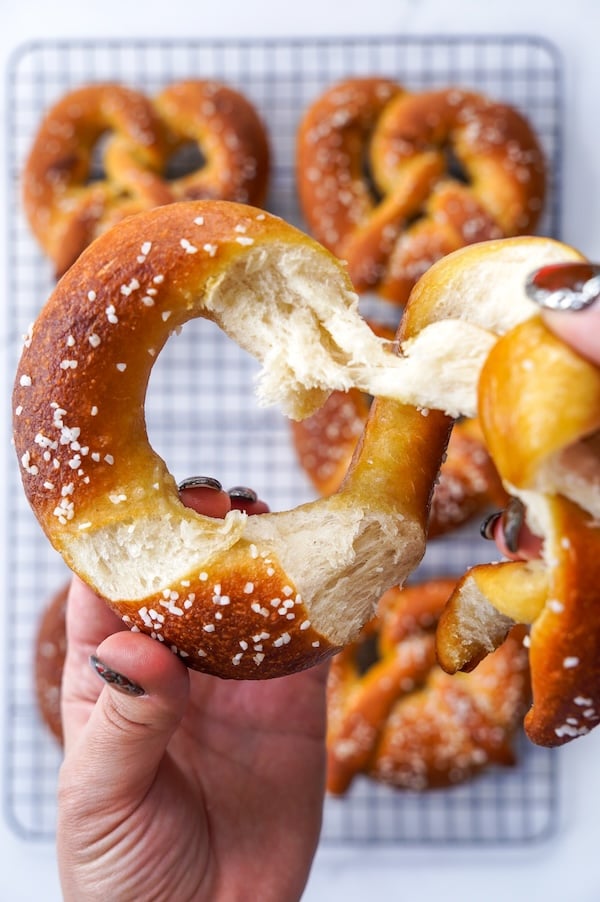

If you’ve been making sourdough bread and want to expand beyond loaves, soft pretzels are the perfect next project. They’re less intimidating than they sound, require just basic ingredients you likely already have, and the payoff is restaurant-quality results that taste infinitely better than store-bought. This guide walks you through shaping, boiling, and baking pretzels that stay soft for days.
How to Make Soft Sourdough Pretzels
Sourdough pretzels blend the tangy depth of fermented dough with the chewy texture of traditional pretzels. The process takes about 24 hours total, but most of that is hands-off fermentation.
Ingredients
- 1 cup active sourdough starter (fed 4-8 hours prior)
- 1 1/2 cups warm water
- 3 1/2 cups bread flour or all-purpose flour
- 1 1/2 teaspoons salt
- 1 tablespoon sugar or honey
- 3 tablespoons baking soda (for boiling water)
Method
Mix the dough
Combine your active sourdough starter, warm water, flour, salt, and sugar in a large bowl. Stir until all flour is hydrated and you have a shaggy dough. Let it rest for 30 minutes to fully absorb the liquid, then knead for 5-8 minutes until smooth and elastic.
First rise and bulk fermentation
Place the dough in a lightly oiled bowl, cover, and let it rise at room temperature for 4-6 hours until doubled in size. You can also do a slower overnight fermentation in the refrigerator (8-12 hours) for more developed flavor.
Divide and pre-shape
Turn the dough onto a lightly floured surface and divide it into 8 equal pieces (about 100 grams each). Roll each piece into a ball, cover loosely, and let them rest for 10-15 minutes. This relaxation makes them easier to shape into pretzels.
Shape into pretzel knots
Take one rested ball and roll it into a 20-inch rope, keeping the thickness even throughout. Bend the rope into a U-shape, cross the ends over each other once, then fold the crossed ends back down and tuck them into the top of the U to create the classic pretzel knot. Place each shaped pretzel on parchment paper.
Final proof
Cover the shaped pretzels and let them proof for 45 minutes to 1 hour until they’re puffy and hold a slight indent when gently poked. They don’t need to double in size like bread; slightly under-proofed is better than over-proofed for pretzels.
Prepare the baking soda bath
Fill a large pot with 2 quarts of water and bring it to a rolling boil. Dissolve 3 tablespoons of baking soda into the water. This alkaline bath gives pretzels their characteristic dark mahogany color and chewy exterior. Work in a well-ventilated area as the baking soda will produce steam.
Boil the pretzels
Carefully transfer 2-3 pretzels at a time into the simmering baking soda water. Let them boil for 30-45 seconds per side (about 1 minute total), then remove with a slotted spoon and place on a clean parchment-lined baking sheet. Don’t skip this step or try to rush it.
Bake until golden
Preheat your oven to 450 degrees Fahrenheit. Top each boiled pretzel with coarse salt, sesame seeds, or everything bagel seasoning if desired. Bake for 14-18 minutes until deep golden brown. Cool on a wire rack for at least 10 minutes before serving, though they’re best eaten warm.
- Use a sourdough starter that’s been fed and is visibly bubbly and active before mixing. A weak starter will result in flat, dense pretzels.
- Don’t skip the baking soda bath. This is what creates the chewy crust and distinctive pretzel flavor. Lye is traditional but baking soda is the safe home alternative.
- If your pretzels seem to be browning too fast in the oven, tent them with foil for the last 5 minutes to prevent burned edges while the centers finish cooking.
What to Look For in Pretzel-Making Equipment
- Large Mixing Bowl: You need a bowl large enough to accommodate dough that will roughly double in volume. At least 3-4 quart capacity prevents overflow and gives you room to work. Stainless steel or ceramic are ideal for durability and temperature retention.
- Slotted Spoon or Skimmer: Essential for safely removing hot pretzels from the boiling baking soda bath without splashing. A long handle keeps your hands away from steam. Look for sturdy, heat-resistant options that won’t warp.
- Wire Cooling Rack: Prevents the bottoms of your pretzels from becoming soggy by allowing air circulation underneath. Elevated racks speed cooling and help maintain that crucial chewy texture.
- Kitchen Scale: Dividing the dough into equal portions by weight ensures consistent-sized pretzels that bake evenly. Digital scales are affordable and far more accurate than volume measurements for dough work.
OXO Good Grips 5-Quart Stainless Steel Mixing Bowl
Best for: Bakers making multiple batches of dough
This heavy-duty stainless steel bowl is sized perfectly for pretzel dough that doubles during fermentation. The brushed finish resists staining from sourdough cultures, and the wide mouth makes shaping easier. The weight and material maintain consistent temperatures during bulk fermentation, crucial for controlled sourdough fermentation. At 5 quarts, you’ll have plenty of headroom without the dough escaping during vigorous mixing.
Check Current Price on Amazon →Cuisinart Chef’s Classic Stainless Steel 12-Quart Stockpot
Best for: Boiling multiple pretzel batches efficiently
This large-capacity stockpot holds enough baking soda water to boil 2-3 pretzels at once without crowding or cooling the bath significantly. The stainless steel construction heats evenly and resists corrosion from the alkaline baking soda solution. Heavy-gauge bottom prevents hot spots that could burn your pretzels unevenly.
Check Current Price on Amazon →Winco Slotted Serving Spoon Stainless Steel
Best for: Home bakers on a tight budget
At a fraction of specialty pretzel tools, this simple slotted spoon safely removes boiling pretzels from the bath without splashing. The 13-inch handle keeps your hands and arms safely away from hot steam. Stainless steel won’t rust or stain from repeated baking soda exposure, and it’s lightweight enough for extended use.
Check Current Price on Amazon →Etekcity Digital Kitchen Scale with Bowl
Best for: Bakers who want consistent results every time
This digital scale measures to 0.1 ounce precision, letting you divide dough into identical 100-gram portions for uniform pretzel sizes and baking times. The removable bowl simplifies cleanup, and the tare function lets you weigh individual pretzels if desired. Battery-powered and compact, it won’t clutter your countertop.
Check Current Price on Amazon →Final Recommendation
Soft sourdough pretzels are achievable for any home baker willing to follow the process carefully. The key is respecting your sourdough starter’s fermentation timeline, mastering the classic pretzel knot shape (which becomes intuitive after your first batch), and never skipping the baking soda bath. Each step serves a critical purpose: the long fermentation builds that distinctive tangy flavor, the alkaline water bath creates the signature chewy crust and mahogany color, and the hot oven delivers the golden-brown finish.
Start with basic equipment you likely already own, and invest in upgrades only as you make pretzels regularly. A simple slotted spoon and wire cooling rack are honestly all you need beyond standard kitchen gear. Once you taste a warm, chewy homemade pretzel with authentic sourdough complexity, you’ll understand why nearly 600 bakers have mastered this recipe. Make your first batch this weekend and join them.
Frequently Asked Questions
Can I make sourdough pretzels without a stand mixer?
Absolutely. Hand-mixing takes about 10 minutes of active work and requires no special equipment. The dough is wetter than sandwich bread but easier to knead than you might expect. Many bakers prefer hand-mixing for better dough feel and control.
What’s the difference between baking soda and lye for boiling pretzels?
Lye is the traditional Bavarian method and creates slightly darker color and more authentic flavor, but it’s caustic and requires careful handling. Baking soda is the safe home alternative that delivers nearly identical results and is available in every kitchen.
How long do soft sourdough pretzels stay fresh?
Freshly baked pretzels are best within 2-3 hours but stay soft and edible for up to 3 days in an airtight container. Reheat in a 300-degree oven for 5 minutes to restore softness. You can also freeze baked pretzels for up to 2 months.
Can I refrigerate the shaped pretzels before boiling?
Yes. After shaping, cover them and refrigerate for up to 12 hours. Cold pretzels take slightly longer to proof at room temperature (add 15-20 minutes) before boiling. Some bakers prefer this method as it develops more sourdough tang.
Why did my pretzels turn out dense and chewy instead of soft?
This usually means over-proofing before boiling or using weak sourdough starter. Aim for pretzels that are puffy but still hold shape when poked. If your starter isn’t doubling within 4-6 hours of feeding, it needs more time to develop before you use it for baking.
As an Amazon Associate, Build & Bloom earns from qualifying purchases. We only recommend products we genuinely think are useful. Prices and availability vary; check Amazon for the latest.
Leave a Reply