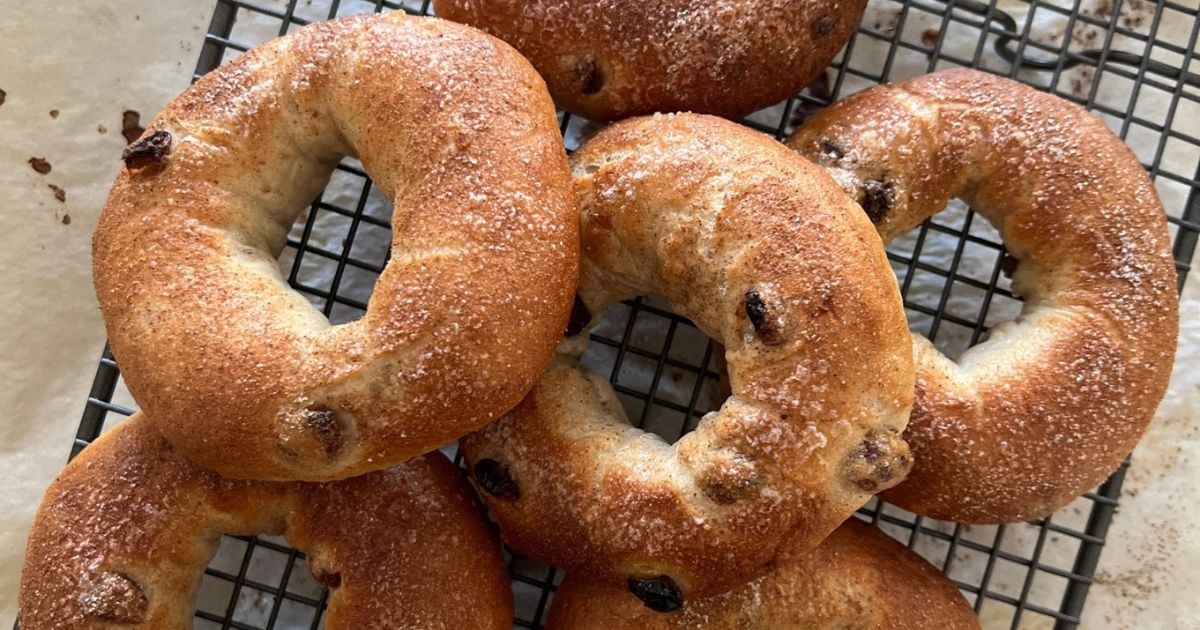

Making bagels at home sounds intimidating, but sourdough bagels are surprisingly manageable when you already have active starter on hand. The key difference from yeasted bagels is the long, cool fermentation that develops complex flavor while the dough becomes perfectly chewy. Adding cinnamon and raisins transforms these into a breakfast-worthy treat that rivals bakery versions–and costs a fraction of the price.
How to Make Cinnamon Raisin Sourdough Bagels
This recipe yields six to eight bagels with deep sourdough tang and spiced sweetness. Plan for a 24-hour process that mostly involves waiting while fermentation does the work.
Ingredients
- 1 cup active sourdough starter (fed 4-8 hours prior)
- 3 cups bread flour or all-purpose flour
- 1 cup lukewarm water
- 1.5 teaspoons salt
- 2 tablespoons honey or sugar
- 1 cup raisins mixed with 1 tablespoon ground cinnamon
Method
Mix the dough base
Combine your active starter, water, and flour in a large bowl. Mix until all flour is incorporated and you have a shaggy dough. Let this mixture rest for 30 minutes at room temperature–this step, called autolyse, helps hydrate the flour and develop gluten without extra kneading.
Incorporate salt and honey
Sprinkle salt and honey over the rested dough. Use wet hands or a dough scraper to fold these ingredients in thoroughly, working the dough for 3-4 minutes. The dough should feel tacky but cohesive. If mixing by hand feels too wet, wet your hands rather than adding flour.
Add cinnamon and raisins
Gently fold the cinnamon-raisin mixture into the dough using a stretch-and-fold motion, being careful not to crush the raisins. Distribute them as evenly as possible. Cover the bowl with a damp cloth and let it rest 15 minutes.
Bulk fermentation
Over the next 3-4 hours at room temperature, perform four sets of stretch-and-fold motions, spaced 45 minutes apart. Each time, simply grab one side of the dough and fold it over itself, rotate the bowl 90 degrees, and repeat. This builds strength without traditional kneading. The dough should feel noticeably airier and lighter by the end.
Cold overnight proof
Divide the dough into six to eight equal portions using a bench scraper or knife. Shape each portion into a loose ball, then poke a hole in the center with your thumb and gently stretch it into a bagel ring, aiming for a 3-inch diameter hole. Place bagels on parchment paper, cover loosely, and refrigerate overnight (12-16 hours). The cold fermentation develops flavor and makes the dough easier to boil.
Prepare boiling water and shape final proof
Remove bagels from the refrigerator. Bring a large pot of water to a boil and add 1 tablespoon honey or baking soda–this raises the pH and helps create that signature chewy crust. Let the bagels sit at room temperature for 20-30 minutes while the water heats.
Boil the bagels
Gently place each bagel into boiling water, working in batches so the pot doesn’t overcrowd. They should sink briefly, then float. Boil for 45 seconds on each side, then remove with a slotted spoon. Place boiled bagels on a wire rack or parchment-lined sheet tray.
Bake until golden
Preheat your oven to 450°F. Transfer bagels to a parchment-lined baking sheet, spacing them 2 inches apart. Bake for 20-25 minutes until deep golden brown. The cinnamon and raisins will caramelize slightly and smell incredible. Cool on a wire rack for at least 10 minutes before slicing.
- Feed your sourdough starter at least 4-8 hours before mixing so it’s at peak activity with plenty of bubbles and a pleasant sour smell.
- Don’t skip the overnight cold proof–this is where sourdough flavor develops and the dough becomes properly structured for boiling.
- If your raisins are hard or dry, plump them in warm water for 15 minutes before mixing into the dough for better texture.
What to Look For in Bagel-Making Equipment
- Large Mixing Bowl: You need a bowl with at least 4-quart capacity that allows room for the dough to expand during bulk fermentation. Glass or food-grade plastic is ideal because you can see through it to monitor progress.
- Bench Scraper or Dough Cutter: Essential for dividing bagel dough cleanly and performing stretch-and-fold motions. A sharp edge lets you portion evenly without compressing the dough unnecessarily.
- Slotted Spoon: A shallow spoon with slots allows water to drain as you remove boiled bagels from the pot. This prevents excess water from making them soggy and keeps your tray dry.
- Wire Cooling Rack: Boiled bagels need air circulation underneath while cooling so steam escapes and the crust stays chewy. A rack elevates them away from the pan and prevents sogginess.
OXO Good Grips 5-Quart Glass Mixing Bowl with Lid
Best for: Home sourdough bakers
This clear glass bowl is perfect for sourdough fermentation because you can monitor dough development without opening the lid. The 5-quart capacity gives ample room for bulk fermentation, and the included silicone lid keeps everything clean while allowing slight air exchange. Glass doesn’t retain odors or flavors, and it’s easy to clean after sticky dough.
Check Current Price on Amazon →Oxo Good Grips Stainless Steel Bench Scraper
Best for: First-time bagel makers
This durable bench scraper has a flat stainless steel blade and comfortable handle that makes dividing dough intuitive. The one-piece construction is dishwasher safe and won’t break during enthusiastic folding. Its straight edge creates clean cuts for evenly-sized bagels that bake uniformly.
Check Current Price on Amazon →All-Clad Essentials 6-Quart Stainless Steel Stockpot
Best for: Serious home cooks
An oversized stockpot makes boiling bagels safer and easier because you have room for several at once without crowding. All-Clad’s thick bottom heats evenly and maintains consistent water temperature, which is crucial for uniform bagel texture. The stainless steel is virtually indestructible and will last decades.
Check Current Price on Amazon →Winco Slotted Spoon Stainless Steel 15-Inch
Best for: Cost-conscious bakers
This long-handled slotted spoon is commercial-grade and engineered to lift wet bagels without tearing or sagging. The slots efficiently drain water while the 15-inch length keeps your hands safely away from boiling water. At this price point, it’s an excellent tool that will last through hundreds of batches.
Check Current Price on Amazon →Start Baking Sourdough Bagels This Week
Making cinnamon raisin sourdough bagels is a weekend project that transforms your active sourdough starter into bakery-quality breakfast. The process is mostly hands-off fermentation, so you’ll spend just 20 minutes of actual work spread across two days. Your first batch might not be perfect, but the flavor will be outstanding, and you’ll immediately understand why experienced sourdough bakers get excited about bagels.
Invest in just a few key tools–a large mixing bowl, bench scraper, slotted spoon, and cooling rack–and you’re set for years of bagel baking. Once you master the cinnamon raisin version, experiment with everything bagels, plain bagels, or even everything-but-the-cinnamon variations. Homemade sourdough bagels are cheaper than the bakery, infinitely more delicious, and they prove that complex fermentation doesn’t require complicated equipment.
Frequently Asked Questions
Can I use regular all-purpose flour instead of bread flour?
Yes, all-purpose flour works fine for sourdough bagels. Bread flour has slightly higher protein content, which creates a chewier bagel, but the difference is subtle. All-purpose flour will still produce delicious results.
What if my sourdough starter isn’t bubbly and active?
Your starter needs one or two feedings at room temperature before use. Feed it, wait 4-8 hours until it doubles with visible bubbles, then proceed. A weak starter will result in sluggish fermentation and less sour flavor.
Can I freeze bagels after baking?
Absolutely. Cool bagels completely, then wrap individually in plastic wrap and freeze for up to three months. Thaw at room temperature or slice and toast directly from frozen. Many bakers say frozen-then-toasted bagels taste even better.
Why did my bagels turn out dense instead of chewy?
Dense bagels usually result from insufficient fermentation or overly tight shaping. Make sure your starter is truly active before mixing, and don’t skip the overnight cold proof. When shaping, be gentle and don’t squeeze out air bubbles.
Do I really need honey or baking soda in the boiling water?
Yes, one or the other is essential. Both raise the pH of the water, which helps form that characteristic chewy, dark crust. Skip this and your bagels will be doughy rather than bagel-like.
As an Amazon Associate, Build & Bloom earns from qualifying purchases. We only recommend products we genuinely think are useful. Prices and availability vary; check Amazon for the latest.
Leave a Reply