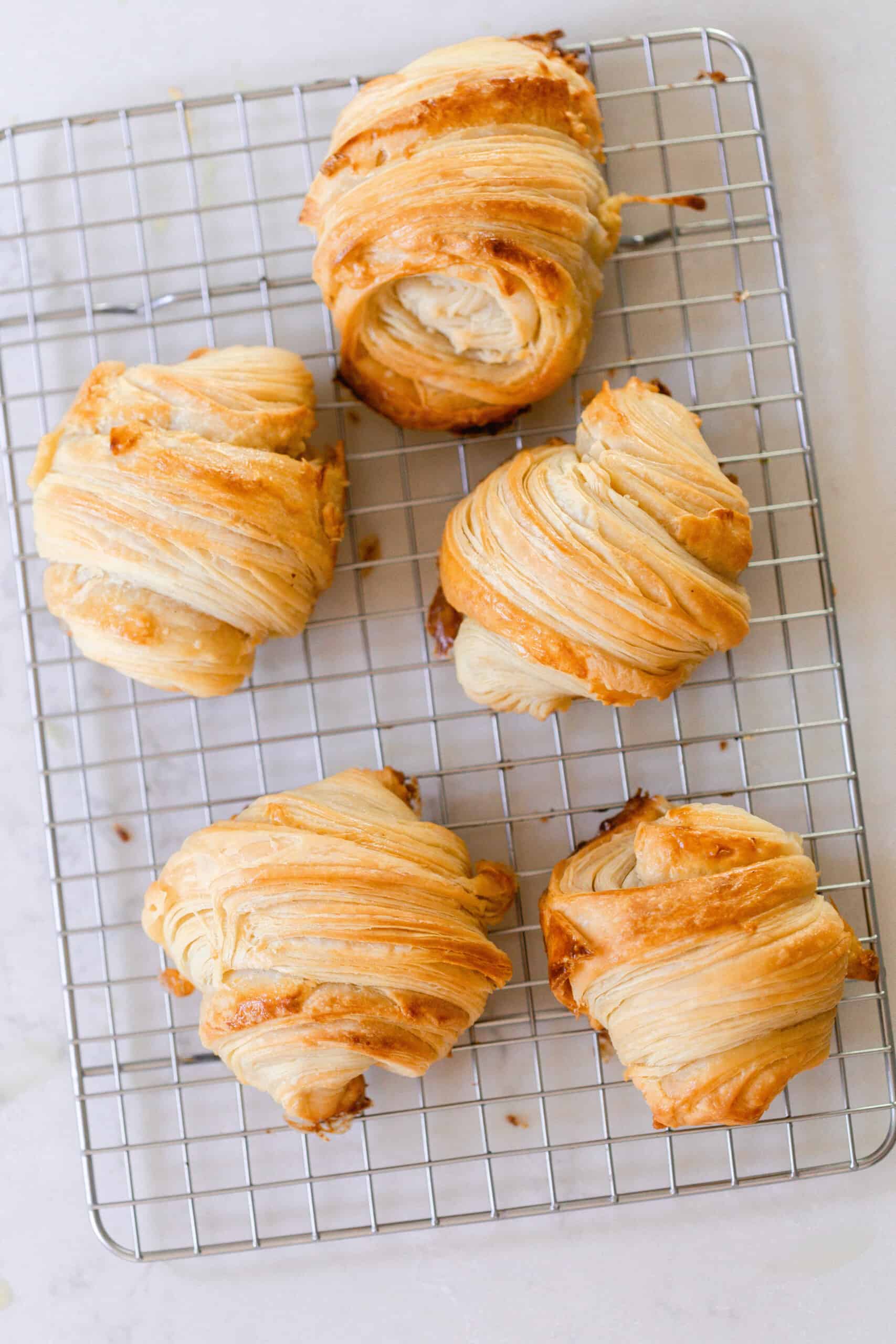

Sourdough croissants are the holy grail of home baking—crispy on the outside, tender within, with that distinctive sour flavor that makes them irresistible. Unlike yeasted croissants, sourdough versions rely on your starter for leavening, giving you deeper flavor and better texture. But the process demands patience, precision, and understanding how cold fermentation develops flavor while lamination creates those signature layers. If you’ve mastered basic sourdough but want to level up, this is your next challenge.
How to Make Sourdough Croissants from Scratch
Sourdough croissants require a multi-day approach with cold fermentation and careful butter lamination. This recipe yields about 12 croissants and showcases how slow fermentation deepens flavor while lamination creates those coveted flaky layers.
Ingredients
- Active sourdough starter (100g, fed and bubbly)
- Bread flour or all-purpose flour (500g)
- Water (250ml, cold)
- Salt (10g)
- Sugar (25g)
- Unsalted butter (250g, cold and cubed, plus 25g for dough)
Method
Mix the dough base
Combine your active sourdough starter, cold water, flour, sugar, and salt in a large bowl. Mix until shaggy, then knead for 5-10 minutes until the dough comes together. It should be slightly stiff but workable. This dough will be your canvas for lamination, so proper hydration matters—not too wet or the butter won’t incorporate cleanly.
First cold fermentation
Shape the dough into a rough rectangle, wrap it tightly, and refrigerate for 12-16 hours. This extended cold rest develops flavor from your starter and begins gluten development. The cold also makes the dough easier to work with when you begin lamination, preventing the butter from melting into the dough prematurely.
Laminate with butter (first fold)
Remove the dough from the fridge and let it sit at room temperature for 15 minutes to soften slightly. Roll it into a rectangle roughly 8 by 12 inches. Distribute cold cubed butter evenly across two-thirds of the dough, then fold the uncovered third over the butter-covered section, then fold the remaining buttered section on top—like folding a letter. Seal the edges and chill for 30 minutes.
Complete lamination cycles
Remove the dough and perform two more letter folds (called ‘turns’). Roll it out, fold into thirds, chill 30 minutes between each turn. After three total turns, your dough contains many thin alternating layers of dough and butter. This is what creates the croissant’s flake. Keep the dough cold throughout—if butter breaks through, dust with flour and chill longer.
Final fermentation
After the third turn, wrap the laminated dough and refrigerate overnight or up to 48 hours. This extended cold fermentation continues deepening sourdough flavor while keeping the lamination intact. The longer rest also develops better oven spring when baking.
Shape and proof the croissants
On a lightly floured surface, roll the dough to a thin, even thickness of about 1/8 inch. Cut into triangles (approximately 4 inches at the base). Roll each triangle from the wide base toward the point, creating a crescent shape. Place on a lined baking sheet and cover loosely with plastic wrap. Allow to proof at room temperature for 6-8 hours, or overnight in the refrigerator.
Egg wash and bake
If doing a final overnight proof in the fridge, remove croissants 30 minutes before baking to reach room temperature. Brush with egg wash (1 beaten egg mixed with 1 tablespoon water) for a golden finish. Bake at 400°F (200°C) for 18-22 minutes until deeply golden and crispy. The internal temperature should reach about 200°F (93°C) when done.
Cool and serve
Transfer croissants to a wire rack and cool for at least 10 minutes before serving. This allows the interior structure to set properly. Fresh sourdough croissants are best enjoyed within a few hours but can be stored in an airtight container for 24 hours or frozen for up to one month.
- Keep all equipment and ingredients cold when working with laminated dough—even a warm kitchen can cause butter to smear rather than create distinct layers. Work quickly and chill frequently.
- If your butter breaks through the dough during lamination, dust the area generously with flour and refrigerate for an extra 15-30 minutes before continuing.
- Don’t rush the fermentation stages. The slow cold fermentation is what develops sourdough’s signature tang and complex flavor—rushing this will yield less flavorful croissants.
Essential Equipment for Making Sourdough Croissants
- Rolling surface and bench scraper: A cool, smooth work surface and a metal bench scraper are essential for laminating dough without sticking. Granite countertops are ideal, but marble or a sealed wooden board works well. A bench scraper helps you lift and fold the dough cleanly.
- Digital kitchen scale: Baking requires precision, especially with sourdough. A scale accurate to 1 gram ensures your starter, flour, and water ratios are exact, which directly impacts fermentation timing and final texture.
- Instant-read thermometer: Monitor dough temperature throughout fermentation. Sourdough fermentation is temperature-dependent—knowing your dough temperature helps you predict rise time and adjust room conditions accordingly.
- Laminated pastry mat or silicone baking mats: Non-stick surfaces prevent dough from sticking during rolling and shaping. Silicone mats are also useful for the final proof, protecting croissants from drafts while allowing air circulation.
OXO Good Grips Digital Kitchen Scale
Best for: Any baker who needs precision
This digital scale is essential for sourdough baking, where ratios matter profoundly. It measures in grams and ounces up to 11 pounds with one-gram accuracy, includes a tare function for measuring multiple ingredients sequentially, and has a large, easy-to-read LCD display. The stainless steel platform is easy to clean and the scale stores flat in a drawer. For sourdough croissants, you’ll use this to weigh starter, flour, water, salt, and butter—getting every measurement right ensures consistent, predictable fermentation and lamination.
Check Current Price on Amazon →Ateco Stainless Steel Bench Scraper
Best for: Laminating and shaping dough
This professional-grade bench scraper is the lamination workhorse. The 6-inch-wide stainless steel blade glides under dough without scratching your work surface, and the beveled edge slides between layers during folding. It’s also perfect for cutting croissant triangles with clean, sharp edges. Pros appreciate the comfortable handle and durable construction that stands up to constant use during multiple lamination turns.
Check Current Price on Amazon →Taylor Precision Digital Instant-Read Thermometer
Best for: Monitoring dough temperature
This affordable instant-read thermometer displays results in 3-5 seconds and reads from 32 to 212 degrees Fahrenheit. The probe is thin enough to insert into dough without causing excessive damage, and the display is large and clear. For sourdough croissants, tracking dough temperature helps you predict fermentation speed and adjust room conditions to maintain optimal 75-78°F conditions during proofing.
Check Current Price on Amazon →Hario V60 Precision Temp Control Scale
Best for: Advanced bakers who weigh ingredients during mixing
This premium scale combines precision weighing with a brewing timer function—useful if you track fermentation visually. It measures up to 2 kilograms with 0.1-gram accuracy, has a smartphone app for logging recipes, and features a sleek design that sits beautifully on any counter. While pricey, serious sourdough bakers appreciate the accuracy and the ability to document their exact recipes for reproducibility across batches.
Check Current Price on Amazon →Start Your Sourdough Croissant Journey
Making sourdough croissants at home is an achievable goal once you understand that it’s not one difficult task, but several straightforward steps performed over several days with proper chilling between each. The key is patience, cold temperatures, and respecting the lamination process—rushing or warming the dough will cause butter to melt into the layers instead of creating distinct flakes. Start with an active sourdough starter you trust, invest in a good digital scale for precision, and don’t skip the cold fermentation stages. Your reward is croissants with superior flavor and texture that no commercial bakery can match.
Once you’ve successfully made your first batch, you’ll understand how manageable the process becomes. Many home bakers develop a rhythm where they mix dough one day, laminate and fold the next, shape and proof the third, and bake on day four. You’ll start to notice how room temperature affects fermentation timing and adjust accordingly. The skills you develop—dough handling, lamination technique, fermentation management—carry forward to all sourdough baking. Each croissant that emerges golden from your oven is proof that you’ve mastered one of baking’s most rewarding challenges.
Frequently Asked Questions
How long do sourdough croissants take to make from start to finish?
The full process takes 3-4 days. Day 1 involves mixing and the first cold fermentation (12-16 hours). Day 2 includes lamination and turns (3-4 hours active work, with chilling between folds). Day 3 includes final fermentation (overnight or 12-24 hours), shaping, proofing (6-8 hours or overnight), and baking. Many bakers break this across multiple days to fit their schedule.
Can I make sourdough croissants without a dedicated sourdough starter?
You need active sourdough starter for authentic sourdough croissants. If you don’t have one, you can build a starter from scratch using flour and water over 5-7 days, or obtain some from a local baker or online source. The starter’s wild yeast and bacteria are what create sourdough’s distinctive tang and the slow fermentation that develops complex flavor.
Why does my butter break through the dough during lamination?
Butter typically breaks through when the dough is too warm or when you’re rolling with too much pressure. Keep everything cold—work quickly, use a cool work surface, and refrigerate between folds. If butter starts breaking through, stop immediately, dust generously with flour, and chill for 30 minutes before continuing. Cold butter should stay as distinct sheets, not smear into the dough.
What’s the difference between sourdough croissants and regular yeasted croissants?
Sourdough croissants rely on sourdough starter for leavening instead of commercial yeast, which produces a more complex, tangy flavor and requires longer fermentation. The extended cold fermentation also develops better flavor and can actually improve lamination by keeping butter from warming. Regular croissants are faster but lack the depth that slow fermentation provides.
Can I freeze sourdough croissants dough before baking?
Yes, you can freeze laminated dough after the final lamination turn (before shaping), or after shaping but before final proofing. Thaw in the refrigerator overnight, then proceed with proofing and baking. Some bakers even bake croissants from frozen—add 2-3 extra minutes to baking time. Freezing actually helps preserve the lamination and can be convenient for batch baking.
As an Amazon Associate, Build & Bloom earns from qualifying purchases. We only recommend products we genuinely think are useful. Prices and availability vary; check Amazon for the latest.
Leave a Reply