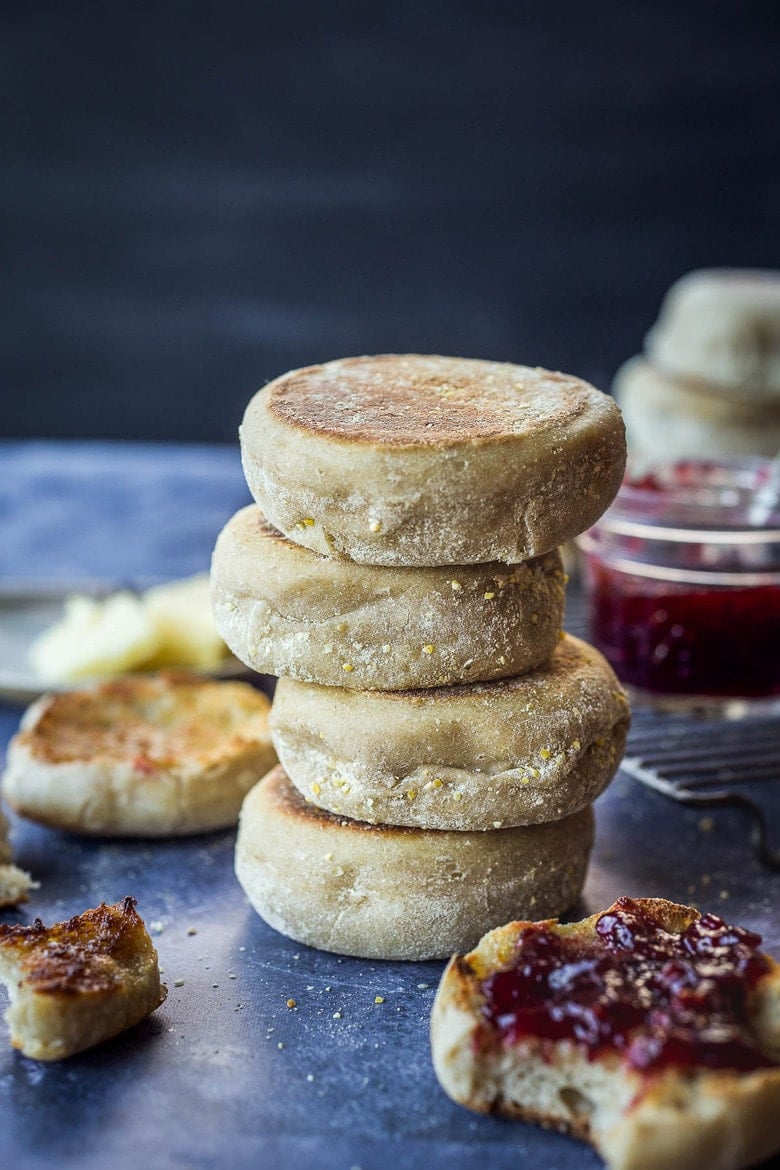

If you keep a sourdough starter on your counter, you already have everything needed to bake English muffins at home. These chewy, holey muffins taste dramatically better than store-bought versions and cost just pennies per batch. The long fermentation builds complex flavor while the starter provides all the leavening power you need—no yeast packet required.
How to Make Sourdough English Muffins
This recipe yields 8-10 muffins and uses only a handful of pantry staples. The dough ferments overnight, making it ideal for baking fresh muffins for weekend breakfast.
Ingredients
- 1 cup active sourdough starter (fed 4-8 hours prior)
- 1 1/4 cups warm water
- 3 1/2 cups bread flour or all-purpose flour
- 1 1/2 teaspoons salt
- Cornmeal or semolina flour for dusting
Method
Mix the dough base
Combine your active sourdough starter with warm water in a large mixing bowl, stirring until mostly dissolved. Add the flour and salt, then mix until a shaggy, somewhat sticky dough forms. You can do this by hand or with a stand mixer on low speed for 3-4 minutes. The dough should feel slightly wet but hold together.
Perform stretch and folds
Let the dough rest for 30 minutes, then perform a series of four stretch-and-fold motions over the next 2 hours (one every 30 minutes). Wet your hand, grab one side of the dough, stretch it up and fold it over the center. Rotate the bowl and repeat on all four sides. This builds strength without kneading.
Bulk ferment overnight
After the final fold, cover the bowl and let it ferment at room temperature for 12-16 hours. The dough should be noticeably puffier and show visible bubbles on the surface. It will roughly double in volume. If your kitchen is cold, fermentation may take longer.
Shape the muffins
Turn the dough onto a lightly floured surface and gently divide it into 8-10 equal portions using a bench scraper or knife. Shape each piece into a smooth ball by folding the edges toward the center and rolling gently on the work surface. Dust both sides lightly with cornmeal or semolina flour to prevent sticking.
Final proof
Place shaped muffins on a parchment-lined tray, spacing them 2 inches apart. Cover loosely and let them proof for 1-2 hours at room temperature. They should puff up noticeably and feel pillowy when gently pressed. If you prefer a tangier flavor, you can refrigerate them for up to 8 hours instead.
Cook on the griddle
Heat a griddle or large flat skillet over medium heat until a drop of water sizzles gently on the surface. Working in batches, place muffins on the griddle and cook for 5-7 minutes on the first side until golden brown. Flip carefully and cook the second side for another 5-7 minutes until both sides are evenly browned.
Cool and split
Transfer cooked muffins to a wire rack to cool for at least 15 minutes. Once cooled to room temperature, use a fork to gently split them along the equator—this creates those characteristic nooks and crannies. Toast before serving with butter and jam if desired.
- An active starter is crucial: feed it 4-8 hours before mixing so it’s at peak rise with visible bubbles. A weak starter leads to dense, flat muffins.
- Don’t skip the overnight fermentation. This long, slow process develops the tangy sourdough flavor and creates the open crumb structure that makes English muffins special.
- Keep your griddle temperature at medium, not high. Too hot and the outside burns before the inside cooks; too cool and they won’t brown properly or cook through.
What to Look For in English Muffin Baking Equipment
- Griddle surface type: Cast iron and steel griddles heat evenly and retain temperature well, essential for consistent browning. Non-stick surfaces are convenient for cleanup but may not develop as much color. Choose based on your preference for crust quality versus ease of washing.
- Size and heating capacity: A griddle wide enough to cook 3-4 muffins simultaneously saves time. Look for one with even heat distribution and sufficient thermal mass to maintain temperature when cold dough hits the surface.
- Bench scraper durability: A sturdy bench scraper with a sharp edge makes dividing dough quick and clean. Flexible scrapers work well for shaping; rigid ones are better for cutting portions and scraping the work surface.
- Proofing vessel: Use a large mixing bowl with a fitted cover or a clear container that shows dough rise. Ability to see fermentation progress helps you time your baking perfectly and prevents overproofing.
Lodge Cast Iron Griddle 17-Inch
Best for: Home bakers seeking restaurant-quality results
This heavy-duty cast iron griddle is the gold standard for English muffin cooking. Its 17-inch surface accommodates 4-5 muffins at once, and the material’s thermal mass ensures even browning without hot spots. Pre-seasoned and ready to use, it develops a naturally non-stick patina over time while delivering the deep golden crusts that define perfectly cooked English muffins.
Check Current Price on Amazon →Ozeri Earth Stone Non-Stick Griddle
Best for: Beginners wanting affordable, low-maintenance cooking
This ceramic non-stick griddle offers excellent value without requiring seasoning or special care. The stone-derived non-stick coating is PFOA-free and performs reliably for English muffins. While it won’t achieve quite the same crust as cast iron, it heats evenly and makes cleanup effortless—perfect for home bakers prioritizing convenience over technique.
Check Current Price on Amazon →OXO Good Grips Stainless Steel Bench Scraper
Best for: New bakers learning to handle and shape dough
This ergonomic bench scraper features a sharp stainless steel blade and a comfortable handle that reduces hand fatigue during repeated shaping motions. The angled design makes it intuitive for dividing dough into portions and cleaning your work surface. Sturdy enough for frequent use yet affordable, it’s an essential tool no baker’s drawer should lack.
Check Current Price on Amazon →All-Clad Ha1 Hard-Anodized Griddle 13 x 20
Best for: Serious home bakers with professional ambitions
All-Clad’s hard-anodized aluminum griddle combines exceptional heat distribution with lightweight durability. The bonded stainless steel cooking surface resists sticking and scratching while developing excellent browning. This griddle conducts heat evenly across its entire surface, eliminating the temperature variations that can plague lesser pans.
Check Current Price on Amazon →Final Recommendation
Sourdough English muffins are an attainable goal for any home baker with a sourdough starter. The recipe itself is simple—five basic ingredients combined and fermented overnight—but the results taste nothing like store-bought versions. The long fermentation develops a complex, pleasantly tangy flavor, while the cooking method creates the tender crumb and those addictive nooks and crannies that catch butter and jam.
Start with whatever griddle or skillet you have at home; English muffins don’t demand fancy equipment. As you develop confidence in the technique, a quality griddle like Lodge cast iron becomes a worthwhile investment that will pay dividends every time you bake. Once you’ve mastered this recipe, you’ll find yourself making English muffins regularly—they’re that much better than anything else available, and the satisfaction of pulling golden muffins off your own griddle is genuinely special.
Frequently Asked Questions
Can I use a regular skillet instead of a griddle for English muffins?
Yes, absolutely. A large skillet works well for cooking English muffins one or two at a time. You’ll just need to work in more batches. Cast iron or stainless steel skillets maintain temperature best and produce the nicest browning.
What if my sourdough starter isn’t very active?
A weak starter produces flat, dense muffins. Feed your starter and wait 4-8 hours until it’s doubled in volume and shows lots of visible bubbles at its peak before using it. If your starter is sluggish, keep it at room temperature and feed it daily for several days until activity improves.
How do I store sourdough English muffins after baking?
Cool them completely, then store in an airtight container at room temperature for up to 3 days. For longer storage, freeze them in a freezer bag for up to 3 months. Toast frozen muffins directly from the freezer until heated through.
Why aren’t my muffins getting those signature nooks and crannies?
Nooks and crannies come from steam and fermentation creating irregular bubbles inside the dough. Make sure your dough is properly fermented (overnight bulk fermentation is crucial), and use a fork rather than a knife to split them after cooling—this tears rather than cuts and reveals the holes inside.
Can I make the dough ahead and bake later?
Yes, this is one of the recipe’s best features. After shaping, refrigerate the muffins for up to 8 hours. Bring them to room temperature (about 1 hour) before cooking, or cook them directly from cold and add 2-3 extra minutes per side.
As an Amazon Associate, Build & Bloom earns from qualifying purchases. We only recommend products we genuinely think are useful. Prices and availability vary; check Amazon for the latest.
Leave a Reply